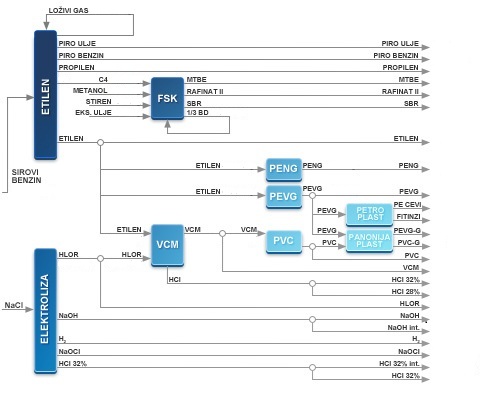
The development plans of the late 1980s were aimed at investing in the chlorine line (Electrolysis→VCM→PVC), in order to modernize the chlor-alkaline electrolysis plant and the PVC plant. These two factories were at an incomparably lower technological level than the other factories of HIP-Petrohemija. The advantage of the new technologies were lower production costs, greater work safety, work automation and compliance with stricter environmental standards.
The most difficult period of the company’s operations occurred in the last decade of the 20th century, when the SFRY collapsed and the market for HIP-Petrohemija’s base and final products drastically decreased. After the introduction of the economic embargo of FR Yugoslavia in 1992, HIP-Petrohemija completely stopped production until 1996. The facilities of HIP-Petrohemija, after the lifting of international sanctions, restarted in September 1996 and the company successfully returned to the domestic and European markets. By 1999, the petrochemical complex was producing over a million tons of petrochemical products per year.
HIP-Petrohemija survived a very difficult period during the NATO intervention in 1999, when it was bombed twice on April 15 and 18. In the bombing, the VCM factory was destroyed and the Electrolysis factory was seriously damaged (which later stopped working), and HIP-Petrohemija was left without 40% of its production capacity. Total damage was estimated at US$449 million. The loss of the chlorine line imbalanced the ethylene line in HIP-Petrohemija, because there was an excess in the capacity of the Ethylene factory of about 100,000 t/year. The PVC factory, which was connected to the VCM factory in terms of raw materials, was thus left without raw materials, although it itself was not damaged in the bombing.
HIP-Petrohemija today – as the only producer of polyethylene and synthetic rubber in Serbia and one of the most important suppliers of domestic and foreign markets, produces more than 600,000 tons of petrochemical products.